
Featured
 Funded Futures Network
- Trade up to 5 funded accounts at one time
- 80% to 90% profit split on payouts
- Multiple evaluation programs
- 40% consistency rule
Code PFD · save up to 70% off
Get the deal From the makers of this calculator: Edge Trader Tools plans, sizes and places your NinjaTrader orders with stop and targets attached.ETT for NinjaTrader: size + brackets
Risk budget, stop distance, and tick value — then floor the result so you stay inside the budget.
By Jordan C.Updated October 27, 2026Methodology
Position sizing determines how many futures contracts you should trade based on your risk tolerance and stop-loss distance. This guide walks through the complete calculation process with real examples.
Where ⌊ ⌋ means "floor" (round down to nearest whole number). You can't trade fractional contracts, and rounding up would exceed your risk limit.
This is the maximum dollar amount you're willing to lose if your stop is hit. Calculate it as either:
Example 1: Fixed Dollar Risk
You decide to risk $300 per trade regardless of account size.
Risk Budget = $300
Example 2: Percentage Risk
Account: $25,000
Risk: 2%
Calculation: $25,000 × 0.02 = $500
Measure the distance from your entry price to your stop-loss level. This must be in points, not ticks or dollars.
Example: ES (E-mini S&P 500)
Entry: 4500.00
Stop: 4490.00
Distance: 4500 - 4490 = 10 points
Note: ES tick size is 0.25, so 10 points = 40 ticks. Don't confuse the two.
Every futures contract has a point value — the dollar amount you gain or lose per 1-point move. This is fixed by the exchange.
| Contract | Point Value |
|---|---|
| ES | $50 |
| NQ | $20 |
| YM | $5 |
| MES | $5 |
| MNQ | $2 |
| CL (Crude Oil) | $1,000 |
| GC (Gold) | $100 |
Find full specifications on the contract specifications page.
Multiply your stop distance (points) by the point value:
Example: ES with 10-point stop
Stop Distance: 10 points
Point Value: $50
Risk Per Contract = 10 × $50 = $500
Example Continued
Risk Budget: $500
Risk Per Contract: $500
Contracts = $500 ÷ $500 = 1.0 contracts
Always round down to the nearest whole contract. Rounding up would exceed your risk budget.
Example: Fractional Result
Risk Budget: $500
Risk Per Contract: $350
Calculation: $500 ÷ $350 = 1.428 contracts
Round down: 1 contract
Actual risk with 1 contract = $350 (safely under your $500 limit)
Let's calculate position size for a Nasdaq (NQ) trade:
Given:
Step 1: Risk Budget
$100,000 × 0.015 = $1,500
Step 2: Stop Distance
15,000 - 14,980 = 20 points
Step 3: Point Value
NQ point value = $20
Step 4: Risk Per Contract
20 points × $20 = $400
Step 5: Divide
$1,500 ÷ $400 = 3.75 contracts
Step 6: Round Down
Final Answer: 3 contracts
Actual risk: 3 × $400 = $1,200 (within $1,500 limit)
Always convert to points. If your stop is 40 ticks on ES (tick size 0.25), that's 40 × 0.25 = 10 points.
If you calculate 2.7 contracts and trade 3, you're risking 11% more than planned. Always floor the result.
ES tick value is $12.50, but point value is $50. Make sure you use point value in the formula.
The basic formula ignores trading fees. If commissions are material ($5+ per contract round-trip), subtract them from your risk budget first.
With Commissions
Risk Budget: $500
Commission per contract: $5 round-trip
Stop Distance × Point Value: $400
Adjusted risk per contract: $400 + $5 = $405
Contracts: $500 ÷ $405 = 1.23 → 1 contract
Risk per contract: 8 × $5 = $40
Contracts: $100 ÷ $40 = 2.5 → 2 contracts
Risk per contract: 50 × $50 = $2,500
Contracts: $500 ÷ $2,500 = 0.2 → 0 contracts (can't trade)
Your stop is too wide for your risk budget. Either tighten the stop, increase risk %, or trade a smaller contract (MES).
Once you understand the formula, open the same NQ example in the position size calculator. The link uses a hash the calculator reads after the page loads, so the address stays free of calculator query parameters.
Disclosure: This site is maintained by a trader who develops Edge Trader Tools, a NinjaTrader add-on. The calculator is free and independent.
| Account | $100,000 |
|---|---|
| Risk | 1.5% = $1,500 |
| Stop | 20 points |
| NQ point value | $20 |
| Risk per contract | $400 |
| Contracts | floor(1500 / 400) = 3 NQ |
From the makers of this calculator From plan to filled brackets, inside NinjaTrader
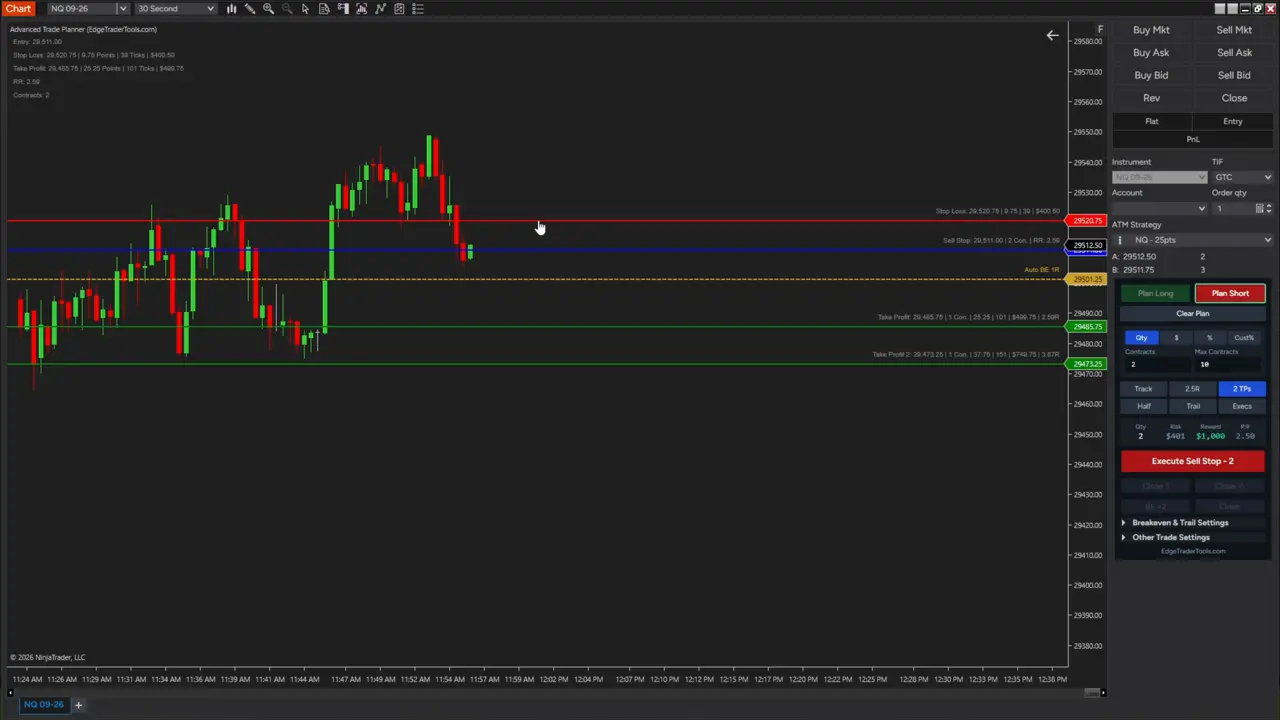
Plan the trade on your NinjaTrader chart, then execute it with one click. Edge Trader Tools does the same math as this calculator, then places the order: stop and targets attach the moment you fill, so there's no window where the position is unprotected.
Live sizing as you drag
Drag entry, stop and target lines. Contracts, dollar risk and R:R update as you move them.
One-click execute with brackets
Sends a limit, stop or market order with your stop and up to 3 take profits attached as OCO.
Manages the trade for you
Auto breakeven, trailing stop, close half or 1 contract, and a half-risk button.
Built for prop accounts
Cust% risks a percent of the balance you enter, like your drawdown, with a max-contracts cap.
 Get Edge Trader ToolsTry NinjaTrader free
$149 one-time · lifetime updates · 7-day money-back
Trade your size with a prop firm's capital.
Featured
Funded Futures NetworkCode PFD · save up to 70% off
Get the deal propfirmdirectory.com
Rules, drawdown types, max contracts and account discounts side by side.
Browse all prop firms