
Featured
 Funded Futures Network
- Trade up to 5 funded accounts at one time
- 80% to 90% profit split on payouts
- Multiple evaluation programs
- 40% consistency rule
Code PFD · save up to 70% off
Get the deal From the makers of this calculator: Edge Trader Tools plans, sizes and places your NinjaTrader orders with stop and targets attached.ETT for NinjaTrader: size + brackets
Complete guide to futures contract conversion ratios and equivalences
By Jordan C.Updated October 27, 2026Methodology
When CME Group introduced Micro E-mini futures in 2019, they set a 10:1 ratio: 10 Micro E-mini contracts equal 1 E-mini contract in dollar exposure. The same 10:1 ratio applies across all micro and E-nano products. This guide explains how equivalences work and why they matter.
Contract equivalence comes from the point value multiplier:
| Contract | Multiplier | Point Value | At 4500 Index |
|---|---|---|---|
| ES | $50 | $50/point | $225,000 |
| MES | $5 | $5/point | $22,500 |
| NES | $0.50 | $0.50/point | $2,250 |
Ratio check: $50 ÷ $5 = 10 (10 MES = 1 ES). $50 ÷ $0.50 = 100 (100 NES = 1 ES). $5 ÷ $0.50 = 10 (10 NES = 1 MES).
The 10:1 ratio means P&L scales proportionally. If ES moves 10 points:
Identical exposure, identical outcome, different contract counts.
If you want to trade 1.5 ES worth of exposure, you can't trade 1.5 contracts (fractional contracts don't exist). But you can trade 15 MES, which equals exactly 1.5 ES.
Many funded accounts cap daily losses at $1,000-$2,000. If you're long 1 ES and it drops 20 points, you're down $1,000 instantly — potentially hitting your limit. Instead:
As your account grows, you can shift from micros to E-minis in 10-contract blocks:
$5K account: 10 MES (= 1 ES exposure)
$25K account: 50 MES (= 5 ES exposure) or switch to 5 ES
$100K account: 20 ES or 200 MES
CME offers micro versions for major indices and some FX pairs, but not all:
You want to trade 2.3 ES worth of exposure on S&P 500:
Option 1: Round down to 2 ES
Underexposed by 0.3 ES ($15/point or 30% less size)
Option 2: Use MES for precision
2.3 ES = 23 MES (2 ES + 3 MES)
Exact sizing, but more contracts to manage
Option 3: Use NES for finest granularity
2.3 ES = 230 NES
Ultra-precise, but commission-heavy for frequent trading
While P&L is equivalent, commission costs are not. If your broker charges $0.50 per side:
| Position | Round-Trip Commission | % of 10-Point Move |
|---|---|---|
| 1 ES | $1.00 | 0.2% |
| 10 MES | $10.00 | 2.0% |
| 100 NES | $100.00 | 20.0% |
Key insight: For very active trading (10+ round trips/day), ES is far cheaper per dollar of exposure. For precise sizing or infrequent trades, micros and nanos make sense.
Use the futures position size calculator to determine how many contracts you need for any exposure level. Enter your risk and stop, then compare across ES, MES, and NES.
CME References:
CME: Introduction to Micro E-minis • CME Equity Index Futures
Disclosure: This calculator is maintained by a trader who develops Edge Trader Tools, a NinjaTrader add-on for position sizing.
From the makers of this calculator From plan to filled brackets, inside NinjaTrader
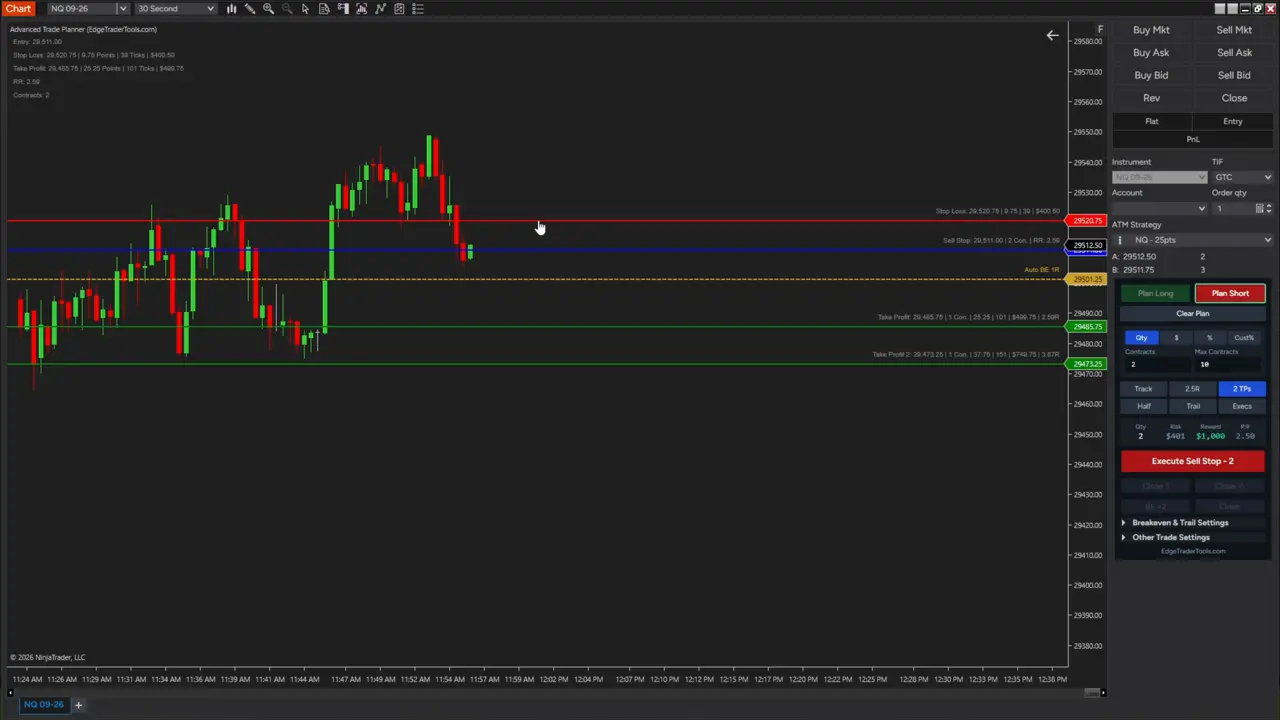
Plan the trade on your NinjaTrader chart, then execute it with one click. Edge Trader Tools does the same math as this calculator, then places the order: stop and targets attach the moment you fill, so there's no window where the position is unprotected.
Live sizing as you drag
Drag entry, stop and target lines. Contracts, dollar risk and R:R update as you move them.
One-click execute with brackets
Sends a limit, stop or market order with your stop and up to 3 take profits attached as OCO.
Manages the trade for you
Auto breakeven, trailing stop, close half or 1 contract, and a half-risk button.
Built for prop accounts
Cust% risks a percent of the balance you enter, like your drawdown, with a max-contracts cap.
 Get Edge Trader ToolsTry NinjaTrader free
$149 one-time · lifetime updates · 7-day money-back
Trade your size with a prop firm's capital.
Featured
Funded Futures NetworkCode PFD · save up to 70% off
Get the deal propfirmdirectory.com
Rules, drawdown types, max contracts and account discounts side by side.
Browse all prop firms