
Featured
 Funded Futures Network
- Trade up to 5 funded accounts at one time
- 80% to 90% profit split on payouts
- Multiple evaluation programs
- 40% consistency rule
Code PFD · save up to 70% off
Get the deal From the makers of this calculator: Edge Trader Tools plans, sizes and places your NinjaTrader orders with stop and targets attached.ETT for NinjaTrader: size + brackets
Understanding the differences between micro, E-mini, and E-nano futures contracts for equity indices
By Jordan C.Updated October 27, 2026Methodology
CME Group offers three contract sizes for major U.S. equity indices: standard E-mini, Micro E-mini, and E-nano. Each serves different account sizes and risk tolerances. This guide breaks down the key differences.
The three sizes form a 10:1 ratio chain for S&P 500, Nasdaq-100, and Dow Jones contracts:
The tick value determines your profit or loss per tick of price movement. This is where contract size directly impacts your risk:
| Contract | Tick Size | Tick Value | Point Value |
|---|---|---|---|
| ES (E-mini) | 0.25 points | $12.50 | $50.00 |
| MES (Micro) | 0.25 points | $1.25 | $5.00 |
| NES (E-nano) | 0.5 points | $0.25 | $0.50 |
Key insight: E-nano contracts have a larger tick size (0.5 vs 0.25 points) but smaller tick value due to the 1/10 multiplier structure. This means E-nanos move in half-point increments, not quarter-points like ES and MES.
CME initial margin requirements (subject to change; verify with your broker):
Day trading margins are typically 25-50% of overnight margins. Brokers may set higher requirements.
Assume you're trading a 10-point stop with $500 risk budget:
ES (E-mini):
10 points × $50/point = $500 risk per contract
Maximum contracts: $500 ÷ $500 = 1 contract
MES (Micro):
10 points × $5/point = $50 risk per contract
Maximum contracts: $500 ÷ $50 = 10 contracts
NES (E-nano):
10 points × $0.50/point = $5 risk per contract
Maximum contracts: $500 ÷ $5 = 100 contracts
All three positions have identical dollar risk ($500) and percentage gain/loss, but E-nanos allow finer position sizing.
A $0.60 round-trip commission represents:
For E-nanos especially, commission-per-contract becomes a significant percentage of profit per point. If your broker charges $0.50+ per side, a 5-point winner on NES ($2.50 gross) loses 40%+ to fees. Negotiate lower rates or trade larger sizes if commissions eat your edge.
E-mini contracts (ES, NQ) have the deepest liquidity — thousands of contracts at each price level during RTH. Slippage is minimal even on larger orders.
Micro contracts (MES, MNQ) have good liquidity but narrower order books. Expect 1-tick slippage on market orders above ~20-30 contracts during RTH.
E-nano contracts (NES, NNQ) launched August 2026 and are still building liquidity. Bid-ask spreads may be wider, and large orders (100+ contracts) can move the market. Use limit orders.
Calculate your exact position size for any of these contracts using the futures position size calculator. Enter your risk budget, stop distance, and select MES, ES, or NES to see how many contracts fit your risk parameters.
CME Spec Sources:
E-mini S&P 500 (ES) • Micro E-mini S&P 500 (MES) • E-nano S&P 500 (NES)
Disclosure: This site is maintained by a trader who also develops Edge Trader Tools, a NinjaTrader add-on for automated position sizing. The calculator is free and independent.
From the makers of this calculator From plan to filled brackets, inside NinjaTrader
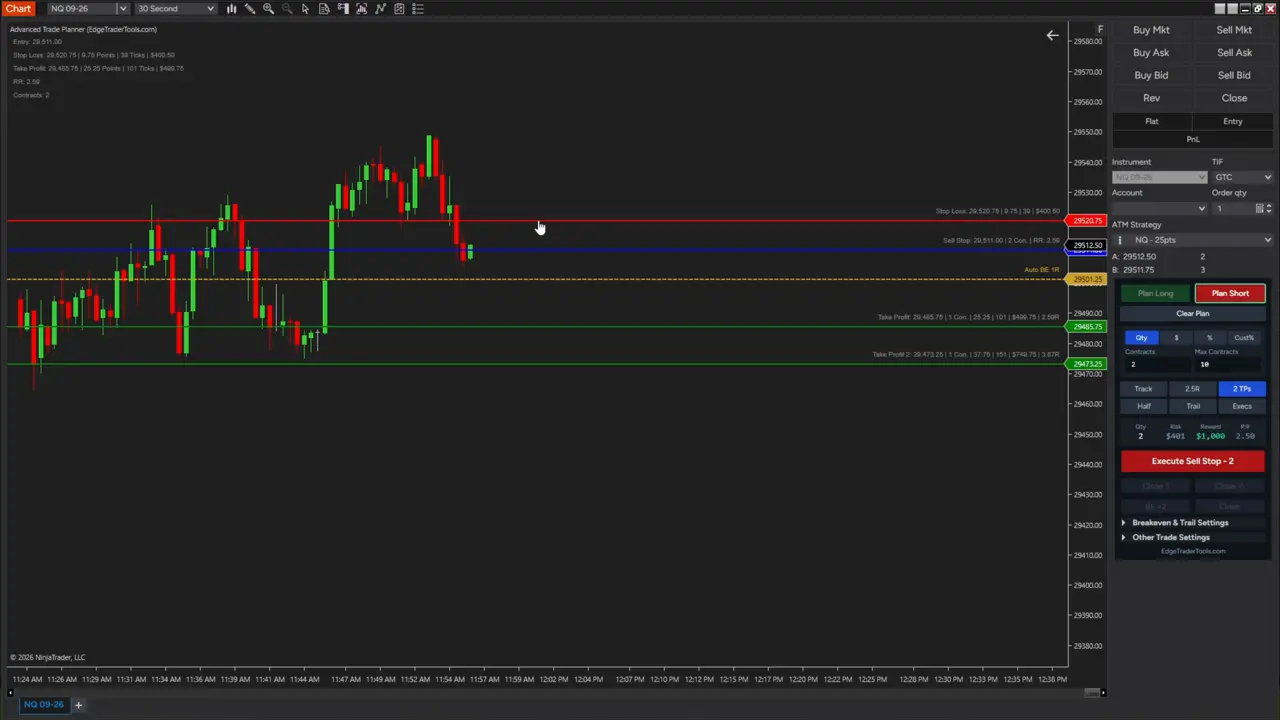
Plan the trade on your NinjaTrader chart, then execute it with one click. Edge Trader Tools does the same math as this calculator, then places the order: stop and targets attach the moment you fill, so there's no window where the position is unprotected.
Live sizing as you drag
Drag entry, stop and target lines. Contracts, dollar risk and R:R update as you move them.
One-click execute with brackets
Sends a limit, stop or market order with your stop and up to 3 take profits attached as OCO.
Manages the trade for you
Auto breakeven, trailing stop, close half or 1 contract, and a half-risk button.
Built for prop accounts
Cust% risks a percent of the balance you enter, like your drawdown, with a max-contracts cap.
 Get Edge Trader ToolsTry NinjaTrader free
$149 one-time · lifetime updates · 7-day money-back
Trade your size with a prop firm's capital.
Featured
Funded Futures NetworkCode PFD · save up to 70% off
Get the deal propfirmdirectory.com
Rules, drawdown types, max contracts and account discounts side by side.
Browse all prop firms